
By Sonal Gupta
First published at nationalobserver.com
April 15th 2026
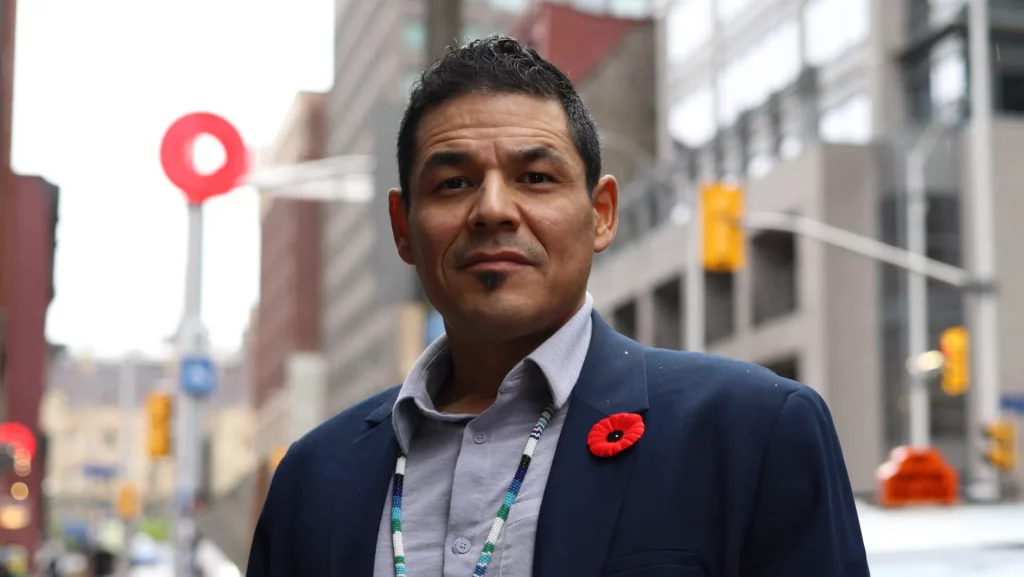
Billy-Joe Tuccaro, chief of the Mikisew Cree First Nation, stands outside AFN’s Ottawa office in November 2025. File photo by: Natasha Bulowski / Canada’s National Observer.
A critical cancer study commissioned by a First Nation remains incomplete because Alberta Health Services hasn’t released health data from 2022 onwards — data the Mikisew Cree First Nation says is essential to prove a link between industrial contamination and rising cancer rates in the northern Alberta community.
At a press conference in Ottawa this week, Chief Billy‑Joe Tuccaro announced preliminary findings showing 149 confirmed cancer cases between 1993 and 2022 in the community of roughly 900 people — and that cancer rates in Fort Chipewyan are at least 25 per cent higher than the rest of Alberta.
But the numbers, he said, are likely much higher — closer to 250 or even 300 by his estimation. That would mean cancer has touched around six out of every 10 households in Fort Chipewyan, directly down the Athabasca River from Alberta’s oilsands.
Tuccaro’s own mother died of cancer less than a year ago. She had gone to the community’s clinic many times, complaining of headaches, before doctors finally discovered she had stage four cancer.
He said the nation is still waiting for Alberta Health Services (AHS) to release more recent data, which he believes could show whether cancer rates spiked following the 2022 Imperial Oil tailings spill near Fort Chipewyan.
“We will go full public with the findings once we get the Alberta Health Services information,” Tuccaro told Canada’s National Observer. “Because without that, it’s incomplete.”
He believes provincial health authorities have withheld the data because its release could confirm what residents have feared for decades: that industrial contamination from oil sands operations, tailings ponds and spills has increased cancer risks downstream.
“They don’t want to say, ‘Yes, what you’ve been saying all along, you’re right,’” Tuccaro said.
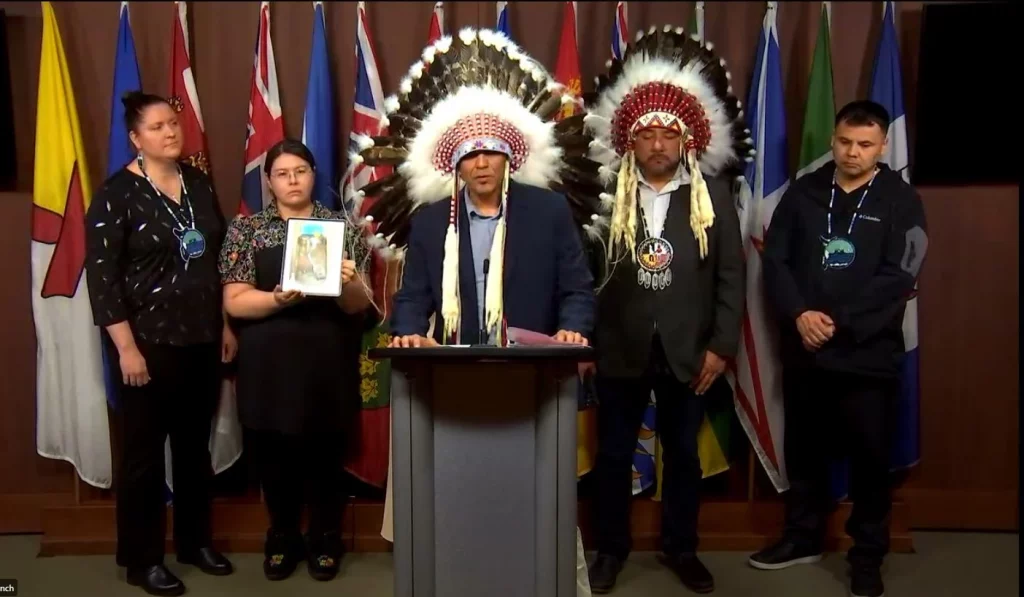
Billy-Joe Tuccaro, chief of the Mikisew Cree First Nation, speaks while flanked by Grand Chief of Treaty 8 First Nations of Alberta Trevor Mercredi in Ottawa on Monday. Screenshot: CPAC.
Canada’s National Observer’s inquiry to Alberta Health Services was redirected to Alberta’s Ministry of Primary and Preventative Health Services. In their response, the ministry noted that their Chief Medical Officer of Health’s report covering cancer rates from 1993 to 2022 found no evidence of pediatric cancer cases in the community and that the vast majority of adult cancer rates fell within normal ranges seen across the province.
“There is no known causal link between oil sands development and cancer rates in the region,” the ministry said. “Thousands of tests also show that our water is safe to drink.”
The department said the province’s cancer registry that tracks all cases and deaths has a lag on completeness, so 2022 data was the most recent available when the report was prepared. Small case numbers require pooling data from multiple years for reliable analysis. Reporting is on schedule with no unusual delays or indication of any change in trends, the ministry added.
Officials pledged to keep reviewing new data as it emerges — including the First Nation’s commissioned study — and to collaborate with First Nations, Métis and Inuit communities to boost access to evidence-based health information.
“Our hearts go out to anyone suffering from cancer, their families and the communities they live in. We understand and take seriously the concerns raised by First Nations communities,” the ministry said.
Ottawa and Alberta continue to advance plans to allow treated oil sands tailings to be released into waterways — part of a broader economic strategy the provincial government says is intended to support industry growth. Under Premier Danielle Smith, the province has ceded more environmental oversight to industry‑friendly regulators, while the technology for treating tailings remains unproven, Tuccaro said.
Government inaction
The First Nation links the crisis to more than 40 years of cumulative exposure to nearby industrial activity, including oilsands development, coal mining and uranium extraction. Tuccaro said the province’s water quality standards may be appropriate for large urban centers like Calgary or Ottawa but are inadequate for communities living directly downstream from tailings sites.
The Mikisew Cree have long called for government action on water contamination, with little progress. After years of inaction while cancer cases continued to rise, the First Nation funded its own health study.
In 2024, the federal government also committed nearly $12 million over 10 years to support the community‑led research examining health impacts linked to the Athabasca oilsands region.
Tuccaro is scheduled to meet with federal ministers this week but he said he has little hope that this week’s lobbying will produce commitments.
Tuccaro met with Indigenous Services Minister Mandy Gull-Masty in Ottawa on Monday, hoping to secure a federal commitment to addressing water quality standards and health infrastructure. But he said the minister deflected responsibility, citing portfolio lines and suggesting other departments should take the lead.
“She’s Indigenous Services Minister and it entails everything. But when we brought up issues, she said, ‘Well, I’m not the minister for it.’ It’s like she’s passing the buck,” Tuccaro said.
Indigenous Services Canada did not respond to a request for comment in time for publication.
Tuccaro said repeated trips to Ottawa have left him frustrated as ministers change and files get reshuffled, while cancer cases continue to pile up in Fort Chipewyan.
Fort Chipewyan is also struggling with a severe lack of proper medical infrastructure. The community has no hospital — only a small clinic staffed by paramedics. For serious health issues, residents go to Edmonton or Calgary, which often delays diagnosis until cancer and other diseases reach advanced stages. Community members are “falling through the cracks,” Tuccaro said.
Many people in the community go to the clinic complaining of headaches, stomach aches or hemorrhoids and are given medicine and sent home. “Then two years later, they finally get a colonoscopy. That’s what’s happening out here.”
He asked the federal government for chartered flights to Edmonton so that community members can access specialists and get early screenings, but so far, the government hasn’t offered any support.
As the environment continues to deteriorate, some residents have started to wonder whether living in their traditional territory is still viable. If relocation becomes necessary, Tuccaro worries that the government would move them into a city — far from the boreal forests and waterways that have always defined Mikisew Cree life.
“We’re bush people. We like to be away from the bigger settings where we can just go hunt, fish and trap,” Tuccaro said.
Under the Impact Benefit Agreement, First Nations consent to industrial activity on their territories in exchange for funding, jobs, infrastructure and environmental safeguards. “We didn’t agree to a partnership for genocide,” he said. “We agreed to partnership and opportunity, not to be used as collateral damage for a few dollars.”
Sonal Gupta / Local Journalism Initiative / Canada’s National Observer.